
中国—加勒比文明互鉴交流会主旨演讲
中英文演讲稿
前言
9月24日,巴哈马驻华大使波莱特·贝瑟尔(Paulette Anne Bethel)到访杭州师范大学,受聘为我校名誉教授,并在中国—加勒比文明互鉴交流会上发表主旨演讲。以下为演讲稿原文及中文译文。
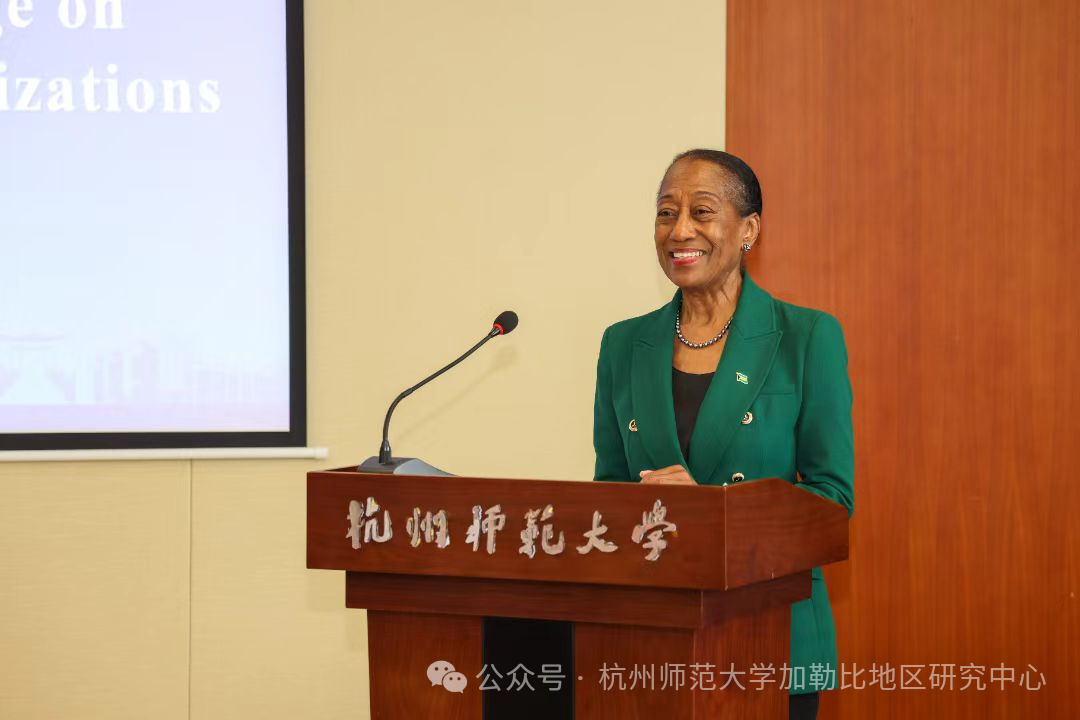
EMBASSY OF THE COMMONWEALTH OF THE BAHAMAS BEIJING, CHINA
Keynote Speech
by
H.E. Dr. Paulette Bethel
at
China‑Caribbean Exchange on Mutual Enhancement of Civilizations
All protocols having been observed, I wish you all a good day, as colleagues and friends.
Today, I would like to begin with a question: When the world is shrouded in clouds of conflict, suspicion, and division, what is it that can truly bring together people who are separated by vast oceans, and make them willing to listen to and engage with one another?
I think the answer is culture, and the people who carry culture.
At Hangzhou Normal University, there is an institution that may not be widely known to the general public, yet it is quietly transforming the landscape of engagement between China and the countries of the Caribbean and that is the Caribbean Centre. I would like to take this opportunity to share with you why this Centre matters — particularly in such turbulent times — and what it ultimately means for the Caribbean, for China, and for the world.
First, it is a bridge that corrects “asymmetric” mutual perception.
For a long time, mutual understanding between China and the Caribbean has suffered from a regrettable “asymmetry”. People in Caribbean nations may have had a vague impression of China garnered through Hollywood films, Western media, and pop music; while for most Chinese people, the Caribbean is often reduced to fragmented symbols like “beaches”, “cricket”, or “reggae”. This poverty of perception can be fertile soil for prejudice and misunderstanding.
The existence of the Caribbean Centre at Hangzhou Normal University is systematically, academically, and with dignity changing this skewed vision. In September 2024, when several of my colleague ambassadors gathered at this University to jointly inaugurate the Centre, the hope was expressed that the Centre would serve as a platform to further strengthen cooperation and exchange between China and the Caribbean. Several of my ambassador colleagues were simultaneously appointed as honorary professors of Hangzhou Normal University — an extraordinarily rare honor in the history of China‑Caribbean relations.
What was the significance of this event, you may ask. It means that the highest diplomatic representatives of Caribbean nations in China chose to personally endorse a research Centre at a Chinese University. This is not merely academic cooperation — this is a vote of confidence at the national level.
I myself visited this great citadel of learning just about a year ago for the launch of the Mandarin translation of the book Running Sideways by Ms. WANG Jianhui. This book tells the story of Pauline Davis, an Olympic champion from The Bahamas who made track and field history. What a great way to begin a conversation between cultures!
Second, the Centre is a bridge of “knowledge production” built on autonomy.
What makes the Caribbean Centre unique is that it is not a transporter of Western academic paradigms, but a builder of Caribbean studies within a Chinese discourse framework. The Centre focuses on four major directions — culture and education, health and medicine, trade and finance, and ecological environment — and is fostering close cooperation with the University of the West Indies and other key Caribbean academic institutions to engage in genuine two‑way dialogue. I sincerely hope that the University of The Bahamas will some day join this circle of cooperation.
Particularly noteworthy is that the major project “A History of Caribbean Literature”, led by Center Director Professor Zhou Min, was approved as a National Social Science Fund Major Bidding Project, opening up a Chinese paradigm for Caribbean literary studies. The publication of the “Caribbean Translation Series” and the “Caribbean Studies Series” is progressing in an orderly manner, and China’s first systematic Caribbean studies curriculum has been established. This means that young Chinese people will no longer understand the Caribbean merely through English or French translations, but can engage directly with Caribbean literature, history, and thought through a Chinese academic lens.
Equality in knowledge is true equality. When Caribbean thought can be read, discussed, and respected in Chinese, that is genuine mutual learning among civilizations.
You will have heard me earlier wax eloquent on the significance of the translation into Mandarin of the book, “Running Sideways” and how it provides Chinese readers with the invaluable opportunity to share directly in some aspects of Bahamian life and experiences. Sharing is the beginning of mutual understanding, respect and cooperation.
Third, it is a pragmatic bridge in times of crisis.
Our era is described by many as one of “turbulence and transformation”. Climate change intensifies, geopolitical tensions rise, and the global economy fragments. For Caribbean island nations, such as The Bahamas, these challenges often mean threats at the level of survival itself.
In this regard, we have encountered our fair share of hurdles, challenges and setbacks, and yet we have risen pushing back against the tides of adversity that have assailed us. Such was the case in September, 2019, when Hurricane Dorian hit The Bahamas with a ferocity never before seen and sat, for days, over some islands of our archipelago, resulting in the tragic loss of many lives and the utter devastation of two islands, in particular.
Similarly, just a year ago in October, 2025 Hurricane Melissa devastated Jamaica, a sister Caribbean nation. In both instances, China was quick to extend a helping hand. Humanitarian actions, such as these are anchored not only in government relations, but also in the academic networks and the human bonds generated by entities such as the Caribbean Centre and the indispensable foundation of trust that they are able to create.
When a Caribbean nation is struck by a hurricane, what China sends is a hospital and health care supplies; when a Caribbean nation needs to strengthen its healthcare capacity, what China brings is technology and training. As a matter of fact, there is a new hospital project ongoing in The Bahamas, which will play an important role in improving the quality of medical services and is a prime example of China’s investment in the social development of my country. This relationship transcends transactional diplomatic rhetoric and enters a deeper realm of jointly facing human vulnerability.
Finally, I would like to talk about this Centre’s contribution to “peace”. We live in an era obsessed with talking about “security” while often neglecting “peace”. Security is walls, deterrence, and balance of power. Peace is bridges, understanding, and the willingness to see the world from the other's perspective.
What the Caribbean Centre at Hangzhou Normal University does is precisely the latter. It provides opportunities for citizens of Caribbean countries to engage face‑to‑face with Chinese students and others and see the real China with their own eyes. When such understanding accumulates sufficiently, it becomes a powerful force for peace. This is an experience more powerful than any diplomatic statement.
I am hopeful that the proposed establishment of China’s first interdisciplinary doctoral programme in “Caribbean International Communication and Mutual Learning of Civilizations”, will not only fill the gap in doctoral training in Caribbean studies in China, but will also be a potent force in moving the needle toward understanding and peace in a world that so desperately needs it. When Chinese doctoral students begin to take the Caribbean as their research subject, when young Caribbean people begin to tell their own stories in Chinese — peace is no longer an abstract concept, but a way of life practiced day after day.
This peacebuilding process is a matter to which President Xi Jinping has spoken when he says,
“We should pursue dialogue and consultation to build a world of lasting peace;
We should pursue joint contribution and shared benefits to build a world of universal security;
We should pursue win‑win cooperation to build a world of common prosperity;
We should pursue exchanges and mutual learning to build an open and inclusive world….”
Dear friends, there is a proverb in the Caribbean which states, “Every mountain has its own height, but they share the same sky.” The significance of the Caribbean Centre at Hangzhou Normal University lies in enabling mountains of different heights to see each other, appreciate each other, and support each other.
In this era of division, we need more bridges like this. We need more people willing to cross mountains and seas, set aside prejudices, and engage in sincere dialogue.
As the renowned Buddhist philosopher and leader, Daisaku Ikeda has said: “Dialogue starts from the courageous willingness to know and be known by others. It is the painstaking and persistent effort to remove all obstacles that obscure our common humanity.” I believe the Caribbean and Hangzhou Normal University have begun that awesome journey with many advantages and benefits to be reaped.
I close by, once again, expressing my appreciation for the privilege of being appointed as an Honorary Professor here and also for the opportunity of this ensuing dialogue.
Thank you. Xie xie.
中国—加勒比文明互鉴交流会
(杭州师范大学,2026年9月24日)
主旨演讲
巴哈马国驻华大使 波莱特·贝瑟尔博士
(巴哈马国驻华大使馆,中国·北京)
在履行了应有的礼节之后,我谨向各位同事、各位朋友问好。
今天,我想先从一个问题谈起:当世界笼罩在冲突、猜疑与分裂的阴云之下时,究竟是什么,能够真正把那些被浩瀚海洋隔开的人们凝聚在一起,使他们愿意彼此倾听、彼此交流?
我认为,答案是文化,以及承载文化的人们。
在杭州师范大学,有这样一个机构,它或许还不为大众所熟知,却正在悄然改变中国与加勒比各国交往的格局,它就是加勒比地区研究中心。今天,我想借此机会与大家分享:这个中心何以意义重大,尤其在当下这样一个动荡的时代更是如此,以及它最终会为加勒比、中国、世界带来什么。
首先,它是一座矫正相互认知“不对称”的桥梁。
长期以来,中国与加勒比之间的相互认知,始终存在一种令人遗憾的“不对称”。加勒比各国人民对中国的印象,或许只是从好莱坞电影、西方媒体和流行音乐中得来的模糊轮廓;而在大多数中国人眼中,加勒比却往往被简化为“海滩”“板球”“雷鬼乐”这样几个零碎的符号。而认知上的这种贫乏,往往正是偏见与误解得以滋生的土壤。
而杭州师范大学加勒比地区研究中心,正以系统、学术而庄重的方式,改变着这种偏颇的认知。2024年9月,我的一些大使同事齐聚这所大学,共同为中心揭牌,并表达了希望中心成为进一步加强中国与加勒比合作交流平台的期许。当时,多位大使同事同时受聘为杭州师范大学名誉教授,这在中加关系史上是一项极为罕见的殊荣。
各位也许会问,这一事件的意义何在?它意味着,加勒比各国派驻中国的最高外交代表,选择亲自对一所中国大学的研究中心给予认可与支持。这已不只是一次学术合作,更是一张来自国家层面的信任票。
就在大约一年前,我本人曾造访这座学术殿堂,出席王剑晖女士所译《侧身奔跑》中文版的首发式。这本书讲述的是巴哈马奥运冠军波琳·戴维斯在田径史上创造历史的故事。以这样的方式开启不同文化之间的对话,是何等美妙!
其次,它是一座以自主性为基石的“知识生产”桥梁。
加勒比地区研究中心的独特之处在于,它不是西方学术范式的搬运者,而是在中国话语框架下建构加勒比研究的建设者。该中心聚焦文化教育、医疗卫生、贸易金融、生态环境四大方向,正与西印度大学等加勒比重要学术机构开展密切合作,展开真正的双向对话。我衷心希望,巴哈马大学有朝一日也能加入这一合作圈。
尤其值得一提的是,由中心主任周敏教授主持的重大项目《加勒比文学史研究》获批国家社科基金重大招标项目,为加勒比文学研究开辟了中国范式。“加勒比译丛”与“加勒比研究系列”的出版正有序推进,中国首个系统的加勒比研究课程体系也已建立。这意味着,中国的年轻人将不再仅仅通过英文或法文的译介来了解加勒比,而能够透过中国的学术视角,直接研读加勒比的文学、历史与思想。
知识上的平等,才是真正的平等。当加勒比的思想能够在中文世界里被阅读、被讨论、被尊重,那才是真正的文明互鉴。
各位方才已听我畅谈《侧身奔跑》中文译本的意义。这一译本为中国读者提供了宝贵的契机,得以直接分享巴哈马生活与体验的某些侧面。分享,是相互理解、相互尊重与合作的开端。
第三,它是一座危机时刻的务实桥梁。
我们这个时代,被许多人描述为“动荡与变革”的时代。气候变化加剧,地缘政治紧张升级,全球经济日趋分化。对于像巴哈马这样的加勒比岛国而言,这些挑战往往意味着关乎生存本身的威胁。
在这方面,我们经历过种种坎坷、挑战与挫折,却一次次挺身而起,顶住了扑面而来的逆境浪潮。2019年9月就是如此,当时飓风“多里安”以前所未有的狂暴袭击巴哈马,在我们的群岛部分岛屿上空盘桓数日,夺走了众多宝贵的生命,尤其是给两座岛屿带来了毁灭性的重创。
同样,就在一年前的2025年10月,飓风“梅利莎”重创了加勒比姊妹国家牙买加。在这两次灾难中,中国都迅速伸出援手。像这样的人道主义行动,所依托的不只是政府间关系,还有加勒比研究中心这类机构所培育的学术网络与人文纽带,以及它们所筑起的不可或缺的信任根基。
当加勒比某国遭受飓风袭击时,中国送去的是一所医院、一批医疗物资;当加勒比某国需要提升医疗能力时,中国带来的是技术和培训。事实上,巴哈马眼下正有一个新的医院项目在建设之中,它将为改善医疗服务水平发挥重要作用,堪称中国投资我国社会发展的一个典范。这种关系已超出事务性外交辞令的范畴,进入共同面对人类脆弱性的更深境界。
最后,我想谈谈这座中心对“和平”的贡献。我们所生活的时代,人们热衷于谈论“安全”,却往往忽视了“和平”。安全是墙、是威慑、是均势;和平则是桥、是理解,是愿意站在对方的角度看世界。
杭州师范大学加勒比地区研究中心所做的,正是后者。它为加勒比各国人民创造了与中国学生等各界人士面对面交流的机会,让他们亲眼看到真实的中国。当这样的理解积累到足够的程度,就会成为推动和平的强大力量。这是一种比任何外交声明都更有力量的体验。
我满怀期待地相信,筹划设立全国首个“中国—加勒比文明互鉴与国际传播”交叉二级学科博士点,不仅将填补中国在加勒比研究领域博士生培养的空白,也将在这样一个迫切需要理解与和平的世界里,成为一股推动世界迈向理解与和平的强大力量。当中国的博士生开始把加勒比作为研究对象,当加勒比的年轻人开始用中文讲述自己的故事,和平就不再是一个抽象的概念,而是一种日复一日践行的生活方式。
关于这一和平建设的进程,习近平主席曾这样指出:
“坚持对话协商,建设一个持久和平的世界;
坚持共建共享,建设一个普遍安全的世界;
坚持合作共赢,建设一个共同繁荣的世界;
坚持交流互鉴,建设一个开放包容的世界……”
亲爱的朋友们,加勒比有一句谚语说:“每座山各有其高度,却共享同一片天空。”杭州师范大学加勒比地区研究中心的意义,就在于让不同高度的山能够彼此看见、彼此欣赏、彼此扶持。
在这个分裂的时代,我们需要更多这样的桥梁,需要更多愿意跨越山海、放下偏见、真诚对话的人。
正如著名佛教哲学家、领袖池田大作所言:“对话,始于了解他人、也让他人了解自己的那份勇气;它是一项锲而不舍的努力,旨在清除一切遮蔽我们共同人性的障碍。”我坚信,加勒比与杭州师范大学已经踏上了这段了不起的旅程,并将收获诸多助益与累累硕果。
最后,我再次感谢能有幸受聘为这所大学的名誉教授,也感谢接下来这场对话的机会。
谢谢大家!谢谢!